
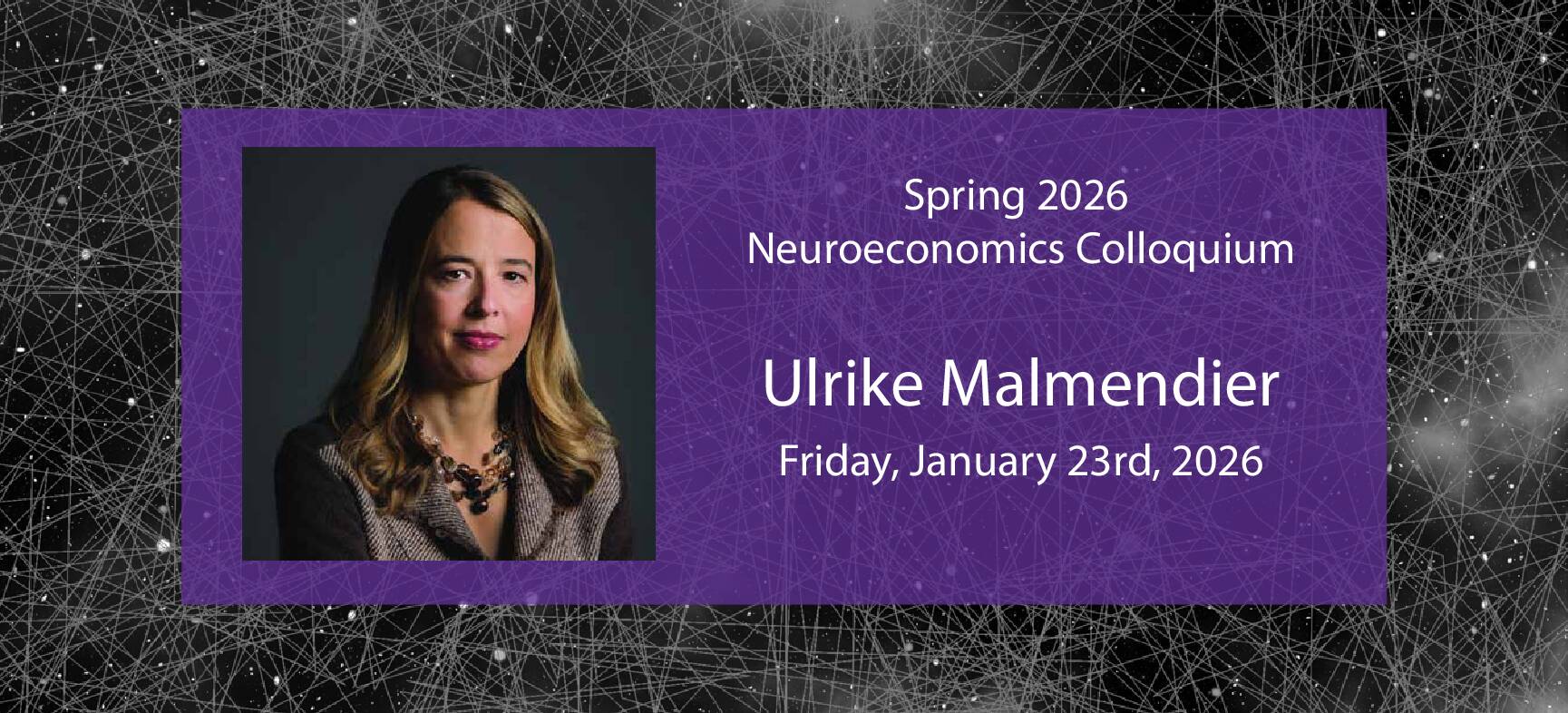
Ulrike Malmendier
Ulrike Malmendier
UC Berkeley
Homo Experiens
Room 636 NYU Meyer Hall, 4 Washington Place
https://nyu.zoom.us/j/99091263165
Abstract
Behavioral economics has improved the psychological realism of theoretical models and empirical predictions in economics by allowing for biased beliefs, non-standard preferences, and cognitive limitations. Yet, humans are still assumed to invariably follow the same (biased or unbiased) model of belief updating and maximize (perfectly or imperfectly) the same set of preferences throughout their lives. I show that, in a wide range of decision-making realms, we obtain significantly better predictions if we account for humans to be shaped by their prior life-time experiences. I argue that, in order to move from the idealized homo œconomicus to modeling a true human (homo), economic theory and empirics need to account for both their minds and bodies to be shaped by past lived experience. I introduce concepts from biology, neuropsychiatry, and medicine that can guide our model of human decision-making and roles of physical modulators.
Speaker Bio
Ulrike Malmendier is the Cora Jane Flood Professor of Finance at the Haas School of Business and Professor of Economics at the Department of Economics, both at the University of California, Berkeley, where she has taught since 2006. In addition to her roles as research associate at NBER, research affiliate at CEPR, faculty research fellow at IZA (a CESifo Affiliate), Guggenheim Fellow and Member of the Academy of Arts and Sciences; she has served as a member of the German Economic Advisory Council since 2022, advising the German government on economy policy. Malmendier holds a PhD in Business Economics from Harvard University (2002) as well as a PhD in Law (summa cum laude) from the University of Bonn (2000).