
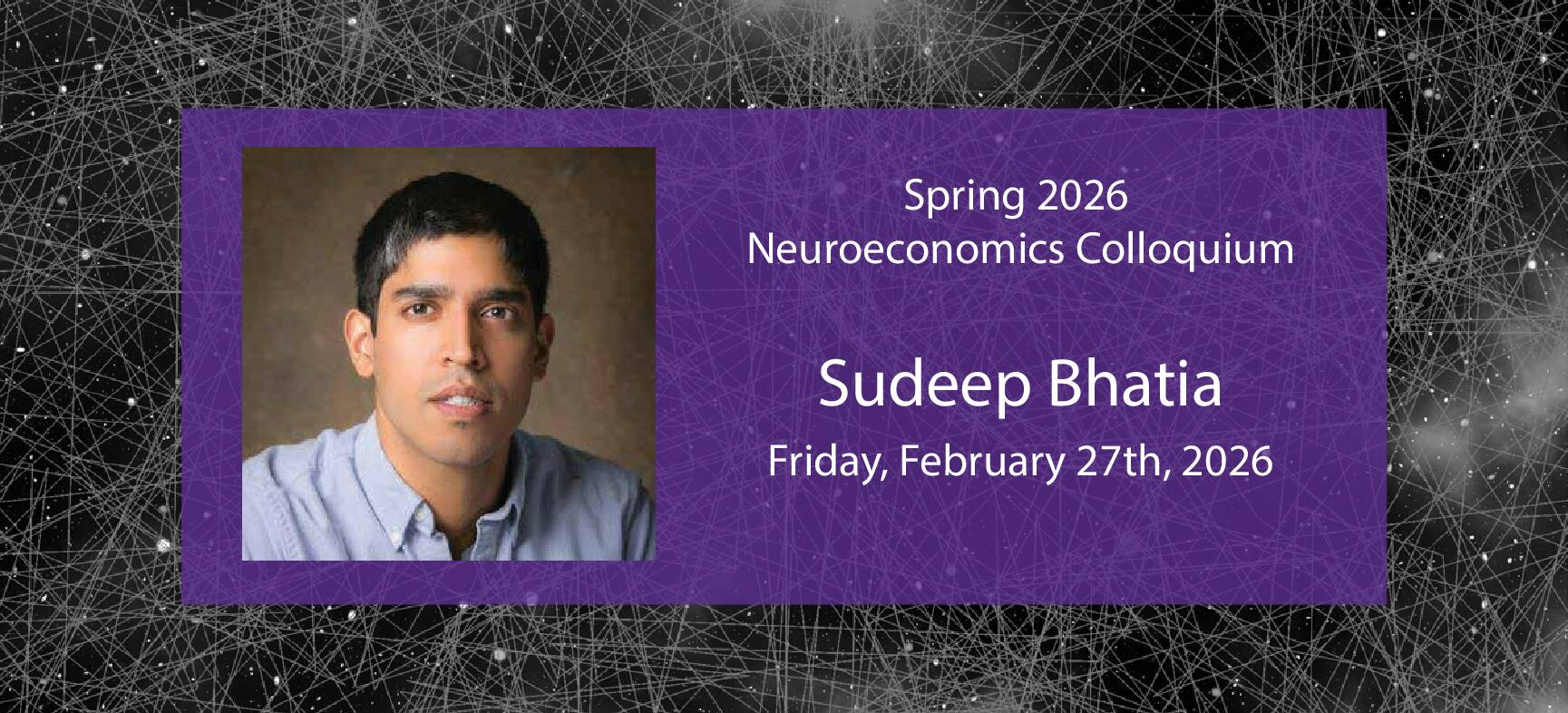
Sudeep Bhatia
Sudeep Bhatia
University of Pennsylvania
Reasons, representations, and real-world decisions
Room 636 NYU Meyer Hall, 4 Washington Place
https://nyu.zoom.us/j/91346088544
Abstract
Everyday choices are guided by reasons, yet reasons have been difficult to formalize within standard models of choice. As a result, choice modeling in the behavioral sciences has largely focused on abstract, highly stylized problems that diverge sharply from the consequential decisions people routinely face in their lives. We introduce a computational framework that uses latent representations from large language models (LLMs) to quantify the semantic content of reasons. The framework maps any natural-language reason onto a vector representation in a multidimensional space. Closely related reasons occupy nearby locations, and individuals who care about the same reasons assign similar weights to the underlying dimensions when making decisions. We show that our approach can be used to accurately predict naturalistic choices, characterize individual differences in terms of preferences over reasons, and formalize the role of memory and attention processes in the retrieval and aggregation of reasons during deliberation. We also apply our framework to a new dataset of over 100K descriptions of real-world choices, revealing the reasons that guide important life decisions and how they vary across individuals and situations. Overall, our work combines the representational power of LLMs with established models in psychology, economics, neuroscience, and marketing, enabling the formal analysis of everyday choices, and the processes that shape them, at scale.
Speaker Bio
I study the cognitive basis of human judgment and decision making with the use of mathematical and computational models. There are two interrelated components of my research program. The first involves understanding how people sample and aggregate information in order to form preferences and beliefs: I extend psychological research on perceptual decision making and memory retrieval to explain behavioral findings in domains such as multiattribute choice, risky choice, and probability judgment. The second component involves specifying the information that is sampled and aggregated in order to form preferences and beliefs. Particularly, I apply methodological insights from semantic memory research and computational linguistics to uncover knowledge representations for objects, attributes, and events that are the focus of everyday judgment and decision tasks.
With progress in both these areas, I aim to build models of judgment and decision making that know what people know and use knowledge in the way people use knowledge. These models should be able to deliberate over and respond to a large variety of everyday decision problems, and moreover, mimic human responses to these problems.